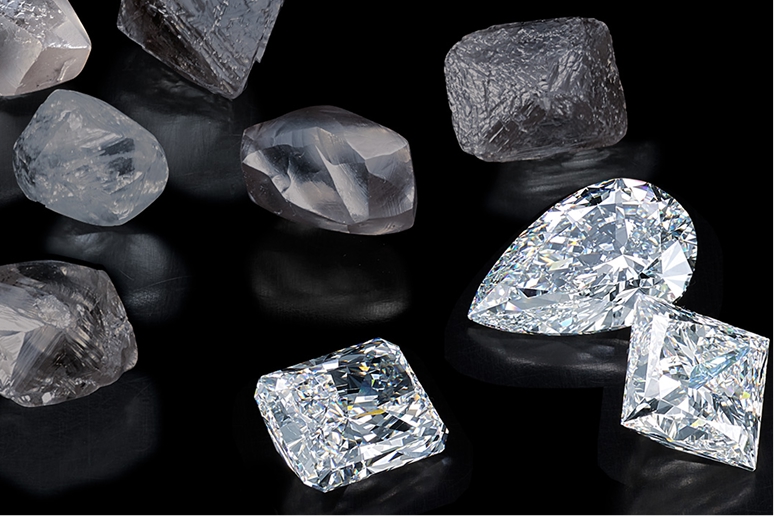
Carat weight is the physical weight of a diamond: One carat is 200 milligrams. You’ll often hear carat weight referred to as the “size” of a diamond. Helzberg carries a wide variety of sizes — the most common range from .25–5 carats.






.jpg)
HOW DIAMONDS ARE certified
Diamond certification guide
.jpg)
getting good grades
What is a diamond grading report?
A diamond grading report or diamond certification report gives you an unbiased evaluation of a diamond by experts working for independent labs. When you choose jewelry that features certified diamonds, you can review documentation that lets you compare the characteristics that determine each diamond’s quality.
Most diamonds include some natural color, which is rated from D (colorless) to Z (light, with a tint of brown or yellow). Because colorless diamonds are exceptionally rare, they get the highest ratings and are the most valuable.
Natural and lab grown diamonds are formed under intense conditions that cause internal and external clarity characteristics. They’re graded from I, for inclusions, to FL, to indicate flawless clarity. Some diamond certifications include a diagram that maps all the unique clarity characteristics of a particular diamond, indicating the locations of both its internal inclusions and external surface blemishes.
It takes expert craftsmanship to perfect the way a diamond interacts with light — and that’s where cutting comes in. A grading report rates a cut diamond’s appearance, including design, proportions, symmetry, and polish, from Fair to Excellent. The words cut and shape can be confusing. “Cut” is about faceting and proportions. “Shape” is about the outline or form of the diamond (square, round, etc.).
Grading laboratories give every diamond a unique certificate or report number that lives in their database. It’s kind of like your car’s vehicle identification number (VIN) — the number will link you to an online report tells you everything you need to know about that diamond. For some larger diamonds, the number is laser-inscribed on the girdle.
Light performance is about brilliance, fire and scintillation. Some labs use specialized diagnostic tools to measure light performance, which tells you how effectively the Diamantaire (the official name for a diamond cutter) faceted a rough diamond into a sparkling masterpiece.
.jpg)
high standards all around
Our diamond grading labs
Helzberg chooses to partner with the strictest diamond grading labs in the industry: GIA for natural diamonds, GCAL and IGI for lab grown diamonds, and GSI for both natural and lab grown diamonds. We set higher-than-usual standards to ensure we source only top quality diamonds. And our internal quality assurance team can be even stricter on diamonds than our partners. Whatever it takes, we want you to get the spectacular diamond of your dreams.

SEE WHAT WE MEAN
Talk to an expert
Helzberg’s diamond experts are used to walking customers through diamond documents. Set up time online or in person, and they’ll show you where to find reports and what to look for so you get exactly the ring you’re dreaming about.
Jewelers can submit diamonds to independent gemological laboratories for evaluation. These gemological labs analyze the diamonds, grade them based on the 4C’s {cut, color, clarity, carat weight} and enter their ratings in a database.
The Gemological Institute of America Diamond Grading Report is a document detailing the assessment of a diamond. The GIA provides different levels of documentation, from a report including ratings or grades for the 4C’s to a Diamond Dossier® with a diagram of the diamond’s proportions. For some round brilliant cut diamonds, the certificate includes the GIA Cut grade.
A diamond certificate is exactly the same as a diamond grading report: It documents the quality of a diamond as determined by independent experts.
A diamond rating chart is another commonly used term for a diamond certification report or a diamond grading report. A diamond rating chart is the document provided by an independent diamond grading lab that verifies the quality of a diamond according to the 4C’s.
A GIA diamond certificate and a GIA diamond grading report mean the same thing and are used interchangeably. They both document a diamond quality check performed by the Gemological Institute of America.
Diamond certification can provide you with peace of mind as you shop for a natural or lab grown diamond. It's an objective assessment of your diamond's quality, keeps you from paying an inflated price and ensures you get the diamond you paid for.
At minimum, a certified diamond will come with an E-report — a digital diamond certificate. You can also look your diamond up online using the number laser inscribed on the diamond’s girdle.
.jpg)
.jpg)